Hobart AM14 and AM15 Dishwasher Repair
Independent diagnostics, repair and preventive maintenance for Hobart AM14 and AM15 door-type dishmachines in restaurants, hotels, schools, care facilities and institutional kitchens where warewashing cannot stop for long.
Identify the machine before anything else
AM14 and AM15 machines were built in several configurations over a long production life. The suffix and configuration change the controls, the water and heating arrangement, the dispensing interface and the parts that fit. Two machines that look identical across a dish room can require different documentation and different parts.
For that reason the complete model and configuration are confirmed first, from the data plate, and sent privately with your request. Nothing on this page assumes that every AM machine behaves the same way, and serial numbers are never published here.
Families and configurations
What this page covers
- AM14 door-type machines in their earlier and later configurations
- AM15 door-type machines, including ventless / Advansys configurations where fitted
- Corner and straight-through installations with differing door and table arrangements
- High-temperature machines with an internal or separate booster
- Machines with different control generations, displays and dispensing interfaces
- AM16 only as a related later family, not as an equivalent machine
Ventless and Advansys configurations add heat-recovery and ventilation behaviour that a conventional machine does not have, so their symptoms are read differently. AM16 is a later family and is mentioned only for context; guidance for one family is not transferred to another.
Service patterns we diagnose
None of these patterns proves a particular failed part. Each one narrows where measurement starts. Related general guides cover drainage and low rinse temperature.
What a technician inspects
On-site sequence
- Complete model and configuration confirmed before any parts discussion
- Fill, wash, rinse and drain stages observed through complete cycles
- Measured temperatures compared against the machine's own documented requirement
- Incoming hot water supply, recovery and booster behaviour where fitted
- Wash and rinse distribution: pumps, nozzles, arms, strainers and scrap trays
- Door or hood interlock and switch operation, and closing alignment
- Water and detergent condition, scale and its effect on heating and results
- Control behaviour, indications and stored fault information for that control generation
- Installation and utility conditions, including drain arrangement and ventilation on ventless units
This page deliberately contains no step-by-step repair procedure, no service or hidden code sequence, no bypass method and no electrical, gas or refrigerant instruction. Please do not remove panels, defeat an interlock or adjust a temperature control to make a reading look correct — those checks belong to the visit, and sanitation decisions remain with the operator and your health authority.
What to tell us when you book
Send these privately with your request
- Complete model and configuration from the data plate, sent privately
- Whether the machine is high-temperature and whether a booster is fitted
- The exact display or indicator text, photographed as it appears
- When the problem occurs — first use, at peak, or every cycle
- Whether the issue affects a whole rack or only part of it
- Recent changes to hot water, filtration, chemicals or the chemical vendor
- When the machine was last deep-cleaned or descaled
- Your service window and whether the machine is still in use
Preventive maintenance and downtime
In a busy dish room, most disruption comes from conditions that were visible earlier: scale building on heating surfaces, worn nozzles and strainers, a door or interlock drifting out of alignment, or dispensing that has changed since the chemical supply changed. Planned inspection documents that condition and its trend so work can be scheduled outside service hours instead of during a rush.
Intervals are set from the exact machine, rack throughput, water condition and the recorded history — not from a universal schedule. Regular maintenance reduces avoidable downtime; it does not guarantee that a failure will never occur, and KONGRA makes no uptime promise. Recurring coverage is arranged through preventive maintenance or a maintenance agreement.
A commercial dish room photograph
The record below is from a KONGRA commercial warewashing visit and is shown only to illustrate the kind of access and inspection described on this page. It is a CMA undercounter machine, not a Hobart machine, and it does not represent a completed Hobart repair.
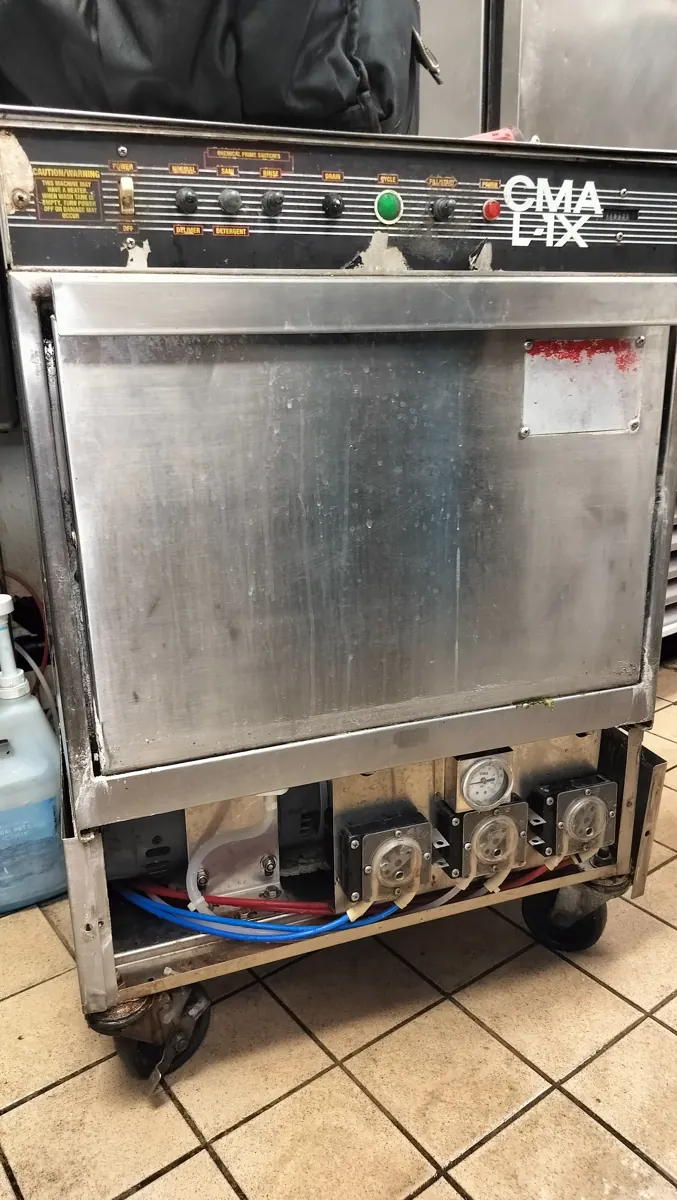
A CMA commercial dishwasher photographed during service with the lower access panel removed and chemical-dispensing components visible.
Manufacturer information
- Hobart door-type ventless operator resources
- Hobart maintenance-kit information for school dish rooms
General facts here are paraphrased from published manufacturer information. Manual text, tables, procedures and manufacturer images are not reproduced. KONGRA LLC is an independent service company and is not affiliated with, endorsed by, authorized or certified by Hobart, and claims no access to proprietary manufacturer systems or warranty administration.
Book a warewashing diagnostic
Book Online is the fastest way to reserve a time. You can also send a service request with the complete model and the display text.