Conveyor Repair & Material Handling Diagnostics in San Jose
Independent, instrument-based diagnostics for selected belt, roller, chain and accumulation conveyors in light production and packaging across San Jose, Los Gatos and the wider Bay Area.
What a conveyor problem is actually telling you
Conveyors are simple to watch and easy to misread. A belt that slips, a drive that stops, a zone that will not release or a jam at one transfer can each come from the mechanics of the machine, from the load and product being run, or from the controls and sensing that decide when the conveyor may move. That is why the first useful step is description rather than adjustment: what changed recently, which zone is involved, and whether it happens loaded, empty or only after the line has been running a while.
KONGRA LLC is an independent service company. It is not an authorized, factory-certified or manufacturer-backed service provider for any conveyor builder or control platform. Manufacturer documents are used as references for the exact model and revision in front of us, and they are never presented as KONGRA work history.
- Belt conveyors in light production and packaging lines
- Roller conveyors, including driven-roller sections
- Chain and slat conveyors within KONGRA's practical scope
- Accumulation sections and transfer units
- Gearmotors, drives, sensors and interlocks fitted to the above
Acceptance depends on the model, the controls fitted and site access. Heavy process plant, high-voltage distribution and safety-rated system validation are outside scope.
Tray conveyor: speed control and belt condition
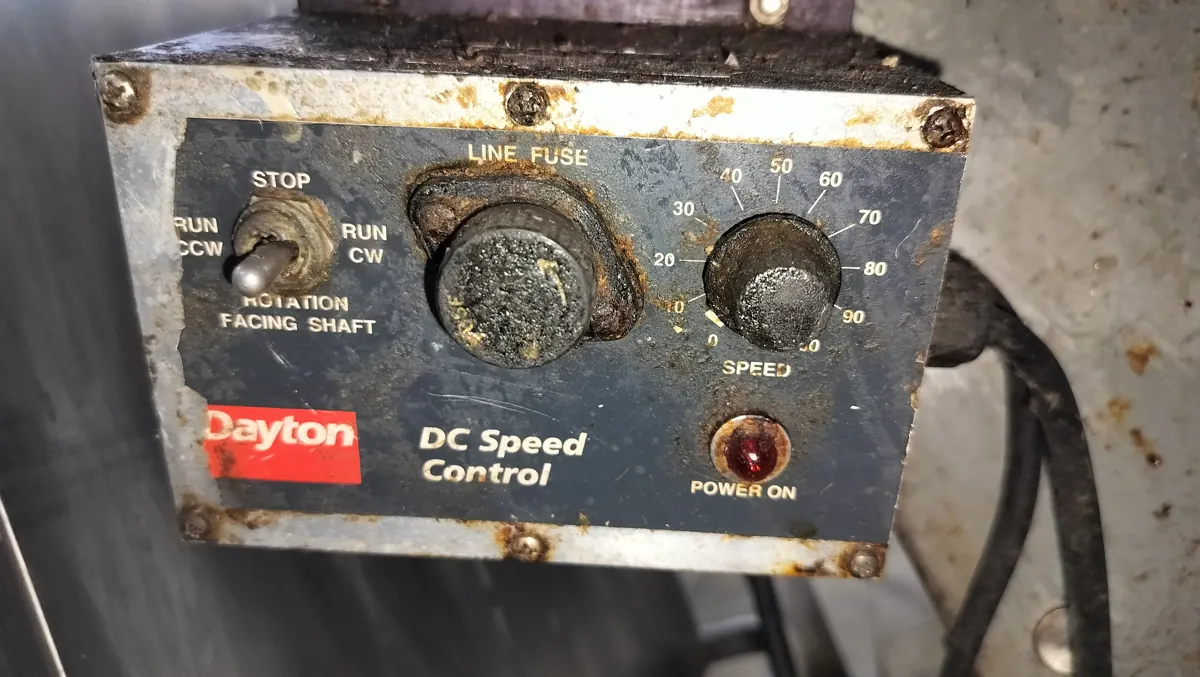
The installed Dayton DC speed control was photographed with visible surface corrosion. Appearance alone does not establish the electrical cause of a stoppage.
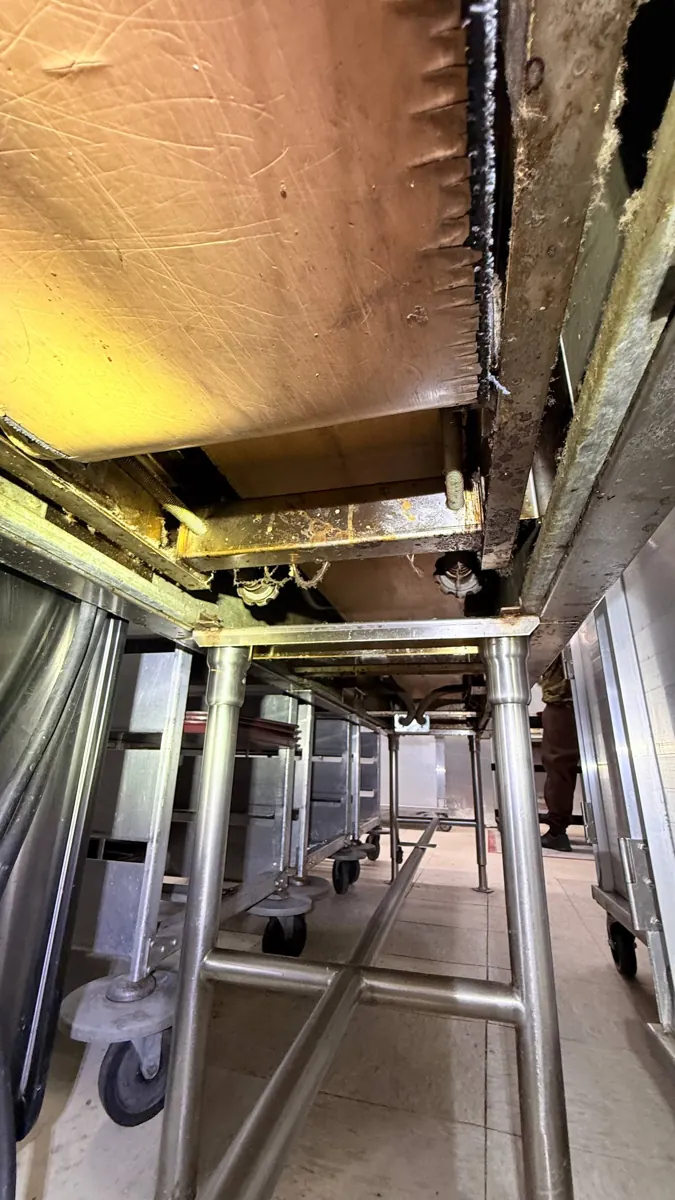
An underside inspection documents belt-edge fraying and deposits around the support structure. Belt condition and mechanical resistance are assessed separately from the motor controller.
A documented tray-conveyor service proposal called for a compatible controller for a permanent-magnet DC motor, followed by speed calibration and a test under operating load. That is a proposed scope; replacement and a completed load test are not recorded. The belt photograph documents a separate condition assessment, not an after-repair result.
For a conveyor that stops, slows or will not respond to its speed control, record whether it happens empty or carrying trays. This helps separate drive-control behavior from belt, roller and load concerns. A DC controller and an AC variable-frequency drive require different assessment and replacement choices.Plan conveyor maintenance.
Five patterns worth separating before a visit
These are categories that narrow the question. They are not a remote diagnosis.
Belt slipping or product not moving with the belt
The drive turns but product does not travel as expected. Load, drive transmission and belt condition are all in scope, and the pattern is recorded before anything is adjusted.
Motor stopped, whole conveyor dead
A stopped drive can be protection acting as designed, a supply or control condition, or a mechanical resistance the drive is reacting to. These are separated on site rather than assumed.
One zone held while the rest of the line runs
On accumulation conveyors a held zone is sometimes expected logic rather than a fault. Which zone, what it was carrying and what the downstream zone was doing all matter.
Jam at a transfer or transition
Transfers combine geometry, product handover and sensing. A jam that only appears at a transition is documented as its own observation.
Tracking wear, edge damage or unusual noise
Wear patterns are evidence. Where on the frame, on which side, and whether it followed a product or layout change are the useful details.
Two of these have their own longer guides: conveyor stops under load and conveyor zone not releasing. Where a drive is reporting a fault, read VFD faults and motor drive diagnostics as well.
Packaging and case sealers
Related equipment on the same line, assessed as separate systems
On a packaging line the conveyor is only part of the story. A case sealer has its own feed belts, its own air system and its own tape heads, and carton geometry can affect feeding and sealing. A carton that is slightly out of square, filled unevenly or a different board grade than last month can change how the machine behaves without anything on the machine having failed.
For that reason the feed belts, the air supply and the tape head are looked at as separate systems with separate evidence, rather than as one “sealer problem”. Telling us which cartons are affected, and whether the carton or the product changed, helps distinguish packaging changes from equipment faults.
3M-Matic 700r case sealer owner’s manual, North America (PDF)
Type 40800 as printed on the cover; document 44-0009-2077-5 B, 070811-NA, July 2011; printed pages 40–42 consulted for how the maker separates carton, belt, air and tape-head observations. It applies to that type only. No manual content or diagrams are reproduced here.
How KONGRA works on conveyors
- Model and revision identified, then matched to the maker's own documentation
- Load, product and recent changes reviewed with your team
- Mechanical condition, drive transmission and sensing assessed on site
- Electrical and control conditions measured after safe isolation where appropriate
- Written findings, then a written estimate; repair only after your approval
- No universal belt-tension or lubrication instructions are published or applied
- Some conveyor components are supplied sealed or lubrication-free and are not opened
- Guards and interlocks are tested, never bypassed or defeated
- Control logic and safety functions are not modified to work around a fault
- Regulated work is performed only within KONGRA's legal license scope, or coordinated with properly licensed independent contractors
What to send with your request
- Conveyor model and serial number from the data plate, and the drive or controller fitted
- Conveyor type: belt, roller, chain or accumulation, and roughly how long the affected section is
- The problem zone or section, and what the rest of the line was doing
- Product being run: size, weight and whether it changed recently
- Change history: layout, speed, product, recent service or parts fitted
These details are optional and help us prepare. Diagnostics are a paid on-site visit; a written estimate follows the inspection and repair proceeds only after your approval.
Source references
Manufacturer references used for this page
- Dorner 2200 Series installation, maintenance and parts manual 851-816 Rev F (PDF)Dorner 2200 Series, 100 pages; maintenance and troubleshooting material on PDF page 29 consulted. That document states no lubrication is required and that V-guided belts do not require tracking adjustment; non-V-guided arrangements are described differently on PDF page 44. Applies to the 2200 Series only.
- Dorner 3200 Series End Drive manual 851-512 Rev G (PDF)Dorner 3200 Series End Drive, 42 pages, © 2010; troubleshooting on printed page 9 and tracking material on pages 12–13 consulted. It does not cover every 3200 configuration and does not cover ARB models.
- Interroll RollerDrive EC5000 user manual, version 3.3 (UL, US/Canada) (PDF)Interroll RollerDrive EC5000, version 3.3, October 2021; overload material on page 16, condition indicators on pages 18–19 and maintenance and troubleshooting on pages 50–51 consulted. AI and BI variants and 24 V and 48 V versions differ; the roller is a sealed unit and is not opened.
Links point to each manufacturer’s own published material for the model scope noted. KONGRA is independent and is not affiliated with, endorsed by or authorized by these manufacturers. Always follow the documentation supplied with your specific equipment.
Frequently asked questions
Which conveyors does KONGRA accept?+
Selected belt, roller, chain and accumulation conveyors used in light production, packaging and material handling. Acceptance follows a scope review of the model, the drive and controls fitted, and the site conditions, because the documentation and the safe working method differ by machine.
Can you tell me the cause from a description over the phone?+
No. A description narrows which investigation is likely and helps us arrive prepared, but one observation on a conveyor can have mechanical, load-related and control-related causes. Confirmation needs measurement on site with the machine in its normal installed condition.
How does a conveyor visit work?+
The visit begins with a paid on-site diagnostic. Findings and measured values are written up, a written estimate follows the inspection, and repair proceeds only after your approval.
Is a conveyor oven the same thing as a conveyor?+
No, and the two pages are deliberately separate. Foodservice conveyor ovens are covered on the conveyor oven repair page. This page is about material-handling conveyors that move product between operations.
Do you publish belt tension or lubrication figures here?+
No. Those values are model-specific and some conveyor components are supplied without any lubrication requirement at all. Applying one machine's figures to another is a common way to cause damage, so tasks are matched to the documentation for your exact model and revision.