Commercial Ice Machine: Low Ice Production
Running out of ice and making less ice are two different problems. This page explains how to tell which one you have, and what a technician actually measures to settle the question.
What the symptom actually tells you
An empty bin at the busiest hour is one way a production complaint arrives. It does not on its own establish that the machine is making less ice. Ice disappears from a bin for reasons that have nothing to do with the machine: demand has grown, service patterns changed, a second station started drawing from the same bin, the bin door is being left open, or ambient heat in the room is melting stored ice faster than it used to.
Reduced production is a narrower and more testable claim. It means the machine is making less ice per cycle or per day than its own published capacity allows under the conditions it is actually installed in. That is a measurement, and it requires knowing both the real conditions and the model's own capacity chart, which is why a generic pounds-per-day figure cannot answer the question.
Conditions matter more than most operators expect, and two different things are often confused. Published capacity is stated at manufacturer-specified ambient air and inlet water temperatures, and output within those limits legitimately falls as those rise — a correctly installed machine in a warm room with warm inlet water within those limits can fall well short of the headline number and still be working as designed. Heat outside those limits is not normal operation. Restricted clearance or a blocked air path is a separate matter: that is an installation or maintenance condition to be corrected, not normal derating.
KONGRA LLC is an independent service company. Diagnosis is a paid on-site visit with instruments and manufacturer service data, followed by a written estimate. Repair proceeds only after your approval.
Separating demand from capacity loss
These are categories to narrow the question before a visit, not a remote diagnosis. Confirmation requires on-site measurement.
- Bin empties at peak service but refills overnightConsistent with demand exceeding rated capacity or with bin melt. It does not rule out reduced capacity, because a machine running all night can still be producing below its rated output. Storage capacity and usage pattern belong in the conversation.
- Output has fallen noticeably with no change in demandThe genuine production question. Confirmed by comparing measured output against the model's capacity chart at the conditions measured on site.
- Cubes are small, thin, incomplete or malformedCan reflect how the freeze cycle is completing, and can also reflect water condition. Record it as an observation; it is not a diagnosis on its own.
- Harvest is delayed, or the machine stops mid-cyclePoints at the harvest side of the cycle and at control behaviour rather than at storage or demand.
- Ice in the bin is fusing, melting or wetRaises bin conditions — insulation, door sealing, drain and room temperature — as things to check. Wet or fusing ice alone does not separate a storage problem from a production one.
- The room is warm, or the machine is boxed inWarm ambient and warm inlet water within the manufacturer-specified operating limits reduce rated capacity legitimately; obstructed clearance or a blocked air path is an installation or maintenance condition instead. Record the room temperature and the clearances rather than estimating them.
- Water supply changed — filter, treatment or building workInlet water condition and temperature bear on both output and ice quality, and a recent change often explains a step drop.
What you can safely observe yourself
All of these are external observations. Nothing here requires opening the machine or touching a moving part.
- Record the room temperature near the machine, measured rather than estimated
- Note the clearances around the machine and whether the air intake or discharge is obstructed
- Note whether the condenser air path looks visibly dust-loaded
- Note whether the drop in supply followed a change in demand, staffing or service pattern
- Note the appearance of the ice: size, thickness, clarity, whether it is fusing in the bin
- Check the bin door closes and seals, and that the bin drain is not blocked
- Note when the water filter was last changed and whether building water work has been done
- Record the make, model and serial number, and photograph any indicator or message
- Do not force or trigger a harvest cycle
- Do not move, bend or adjust the water float, curtain, probe or any sensor
- Do not remove panels or reach into the machine while it is running
- Do not chip, pry or hammer ice from the evaporator
- Do not use unapproved cleaners or sanitizers in the water circuit
- Do not switch the machine off and on repeatedly to try to force production
What requires a technician on site
- Measured output over a full cycle compared against the model's published capacity chart
- Ambient air and inlet water temperature measured at the machine, not assumed
- Freeze and harvest cycle timing observed and compared against the model's service data
- Condenser condition, airflow and heat rejection assessed
- Water inlet condition, flow, treatment and scale condition
- Control and sensor behaviour read against the manufacturer's service documentation
- Sealed-system assessment where indicated — regulated refrigerant work performed only within KONGRA's legal service scope
- Modular, undercounter, self-contained and remote-condenser machines differ substantially; the model determines what is checked
- Hoshizaki KM cubers in the J and Z series and Hoshizaki IM square-cube machines use different ice-making arrangements and different service data; a KM procedure does not describe an IM machine
- Scotsman Prodigy and Prodigy Elite are separate generations with different controls and indicators; guidance for one is not read onto the other
- A machine that stops because the bin control is satisfied is not the same finding as a machine running a slow or extended ice cycle — the two are separated by observation, not assumed
- Expected output is read from your model's own capacity chart at measured conditions — KONGRA does not quote a generic figure, and no universal code list applies across manufacturers
- Refrigerant work is regulated and is performed only within KONGRA's legal license, insurance and practical service scope
- Water treatment system design and building plumbing modification are not KONGRA services
- Sanitation and deep-clean programmes are performed to the manufacturer's specified method and products for the model
- KONGRA is not affiliated with, endorsed by or authorized by any ice machine manufacturer
What to send with your request
The more of this arrives up front, the more useful the first visit is.
- Make, model and serial number from the rating plate
- Whether the complaint is an empty bin at peak or a measured drop in output
- Room temperature at the machine and a photo showing clearances
- Ice appearance — size, thickness, clarity, fusing in the bin
- Any recent change in demand, water filtration or building water supply
- Any indicator, message or code on the machine, photographed
- Your service window and whether a temporary ice supply is in place
Real KONGRA equipment documentation
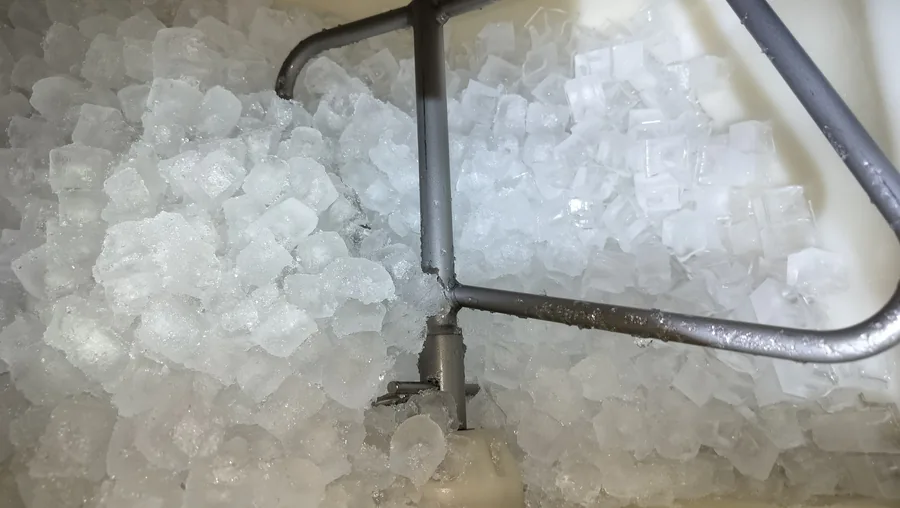
Commercial cuber ice bin and distribution area documented during inspection. Ice appearance alone does not establish performance.
Commercial Ice Machine RepairThis photograph documents commercial ice machine equipment as installed context only. It is not a record of a production-loss repair, and no diagnosis or outcome for the symptoms described on this page is implied by it.
Manufacturer references
- Hoshizaki America — service and training resourcesHoshizaki equipment only. Capacity, cycle behaviour and service procedures differ by manufacturer and model.
- Hoshizaki KM-350/420/520/660M J and Z service manual (PDF)Hoshizaki KM-350MAJ/MAZ through KM-660M J and Z models only (73230, revised July 7, 2026). Does not describe IM series machines or other manufacturers.
- Scotsman Prodigy Elite cuber service manual (PDF)Scotsman Prodigy ELITE MC-series cubers only (January 2022). It does not cover every later machine: earlier Prodigy machines and flake or nugget machines use different controls and service data, and newer R-290 MC1030 units are addressed separately in Scotsman product-service bulletin PS13-2025. The exact model, refrigerant and document generation are confirmed from the data plate before any procedure is applied; the 2022 procedure is not transferred to new R-290 units.
Relevant service pages
Frequently asked questions
The bin is empty by mid-service. Does that mean the machine is failing?+
Not necessarily. An empty bin is a supply-versus-demand observation, and demand changes: a busier period, a new drink programme, a second bar running off the same machine, or a bin that is being scooped down faster than the machine was ever rated to refill it. Reduced production is a different claim, and it is established by comparing measured output against the model's own published capacity under the conditions on site.
The ice looks small, thin or cloudy. Is that a production problem?+
It is a related but distinct observation, and worth recording. Cube size, thickness and clarity can reflect how the freeze cycle is completing, but they can also reflect water condition or bin storage, so appearance alone does not establish a production fault. Report it alongside the output complaint rather than in place of it.
Why do you ask about the room temperature and the water?+
Because published capacity for an ice machine is stated at specific ambient air and inlet water temperatures, and real output falls as those conditions get warmer. A machine in a hot back-of-house corner with warm inlet water can be working exactly as designed and still produce noticeably less than the number on the spec sheet. Establishing the conditions is part of establishing whether there is a fault at all.
Can you tell me how many pounds per day we should be getting?+
Only from your model's own published capacity chart, read at the conditions measured on site. KONGRA does not quote a generic figure or a rule-of-thumb harvest time, because both vary by model and by conditions and a wrong number leads to the wrong conclusion.
Can we speed up the harvest or free the ice ourselves?+
No. Do not force a harvest, move the water float or curtain, or interfere with any moving part or sensor. Beyond the injury risk, it changes the machine's state and destroys the very cycle behaviour the technician needs to observe.