Miele CVA Milk System Repair
Independent diagnostics and repair for the milk path on Miele CVA built-in coffee machines — the line, the air intake, the frother assembly and seals, and the cleaning programme that keeps them clear.
What the symptom actually tells you
On a CVA built-in machine the milk path is a short, tightly toleranced circuit: the milk container and lid, the milk line, the air intake, the frother or cappuccinatore assembly with its seals and valves, and the cleaning programme designed to keep all of that clear. Several quite different faults along that circuit reach the customer as the same complaint about froth.
Because of that, the useful first step is not to identify a part but to describe the behaviour precisely. A machine that draws no milk at all is a different investigation from one that delivers steam without milk, which is different again from one producing froth that is simply thin or inconsistent, or from one that interrupts its cleaning routine.
KONGRA works the circuit in order rather than replacing the visible part first. The container and line are checked for fit and restriction, the air intake is checked, the frother assembly is opened and inspected for residue and seal condition, valve operation is observed during a live cycle, and any stored message is read against Miele service data. Findings are written down before a part is recommended.
The generation matters as much as the symptom. CVA 6xxx and CVA 7xxx machines are documented in separate owner guides, and they differ in the frother and milk-connection arrangement, in how the cleaning and rinsing routines are started and confirmed, and in the wording and numbering of displayed messages. Care instructions written for one generation should not be followed on the other, which is why the model number is asked for before anything else.
It also helps to separate the three drinks the machine makes. If plain coffee is normal but milk drinks fail, the investigation starts in the milk path. If hot water is weak or absent as well, the water circuit is in scope. If coffee, hot water and milk are all affected, the assessment expands beyond the milk path to shared water, heating and control functions. Say which of the three still works normally.
Diagnosis is a paid on-site visit and a written estimate follows the inspection. Repair proceeds only after your approval.
Which milk-system behaviour are you seeing
These categories narrow the investigation before the visit. They are not a remote diagnosis; confirmation requires inspection of your machine.
- No milk is drawn at allPoints at the draw path: container and lid fit, the milk line and its connection, restriction along the line, and the assembly's ability to pull milk through.
- Steam or hot water only, no milk in the drinkIndicates that steam or hot water is being delivered while milk is not. That is a useful distinction to report, though it does not by itself confirm that the steam and water circuits are fully healthy.
- Froth is weak, thin or inconsistent between drinksPoints at the air-to-milk relationship: air intake condition, assembly and seal condition, and residue in the milk path. Exactly which components are involved depends on the frother design used on your model.
- The cleaning programme starts but does not completePoints at the cleaning circuit and its sensing rather than at frothing performance, and at whether the specified cleaning product and method are being used.
- Water or milk appears in the drip trayCan originate in the milk path, the brew unit, the water circuit, condensate or internal drainage. Photograph it before wiping and note which drinks precede it.
- A message or code is displayedThe control is already reporting something. Photograph it exactly as shown; the wording and any code are the technician's starting point.
What you can safely observe yourself
These are normal operating and care actions using the machine's own controls and removable parts.
- Record the model number from the appliance rating plate — CVA series differ
- Note which of the behaviours above matches, and whether it happens on every milk drink or intermittently
- Check the milk container, lid and line are seated and connected as the manual shows
- Note when the milk-system cleaning programme was last run and whether it completed
- Run only the machine's own cleaning programme, with the cleaning product specified by Miele for your model
- Photograph any displayed message, code or icon exactly as it appears
- Note any liquid in or under the drip tray, and when it appears
- Inspect the milk line supplied for your model for visible damage; use only the line and container specified for the machine
- Do not poke needles, wire or sharp tools into the frother, venturi, air intake or any orifice
- Do not mix cleaning products, or substitute a household or generic chemical for the specified milk-system cleaner
- Do not use a milk line, container or connector that is not specified for your model
- Do not dismantle the frother assembly beyond the parts the manual shows as user-removable
- Do not remove machine panels, or work on a built-in appliance while it is powered
- Do not run descaling as a way of testing a milk-path complaint
What requires a technician on site
- Milk line and connection restriction assessed along the full draw path
- Air intake and frother-assembly condition inspected rather than inferred from froth quality, according to the design used on your model
- Frother or cappuccinatore assembly opened, inspected and its seals assessed
- Valve operation observed during a live cycle
- Cleaning programme behaviour and its sensing observed end to end
- Water circuit and scale condition assessed separately from the milk path
- Stored messages and machine data read against Miele service documentation
- Miele CVA built-in coffee machines; the model number from the rating plate determines the assembly, the cleaning programme and the applicable Miele guidance
- CVA series differ in frother and milk-connection design — guidance for one series does not transfer to another
- Consumables, cleaning products and the milk line are used to Miele's specification for the model, not substituted
- Built-in cabinetry modification and appliance installation carpentry are not KONGRA services
- Parts availability can limit repair on older units; KONGRA will say so rather than quote around it
Useful observations
- Model and serial number from the appliance rating plate — the exact CVA number, not just "CVA built-in"
- Whether plain coffee, hot water and milk drinks each still work normally
- Which milk-system behaviour matches, and whether it is constant or intermittent
- When the milk-system cleaning programme last ran and whether it completed
- A photograph of any displayed message or code
- Whether liquid appears in the drip tray, and after which drinks
- Which milk line and container are in use, and whether either was recently replaced
- Access details for a built-in installation, and your preferred service window
Real KONGRA equipment documentation
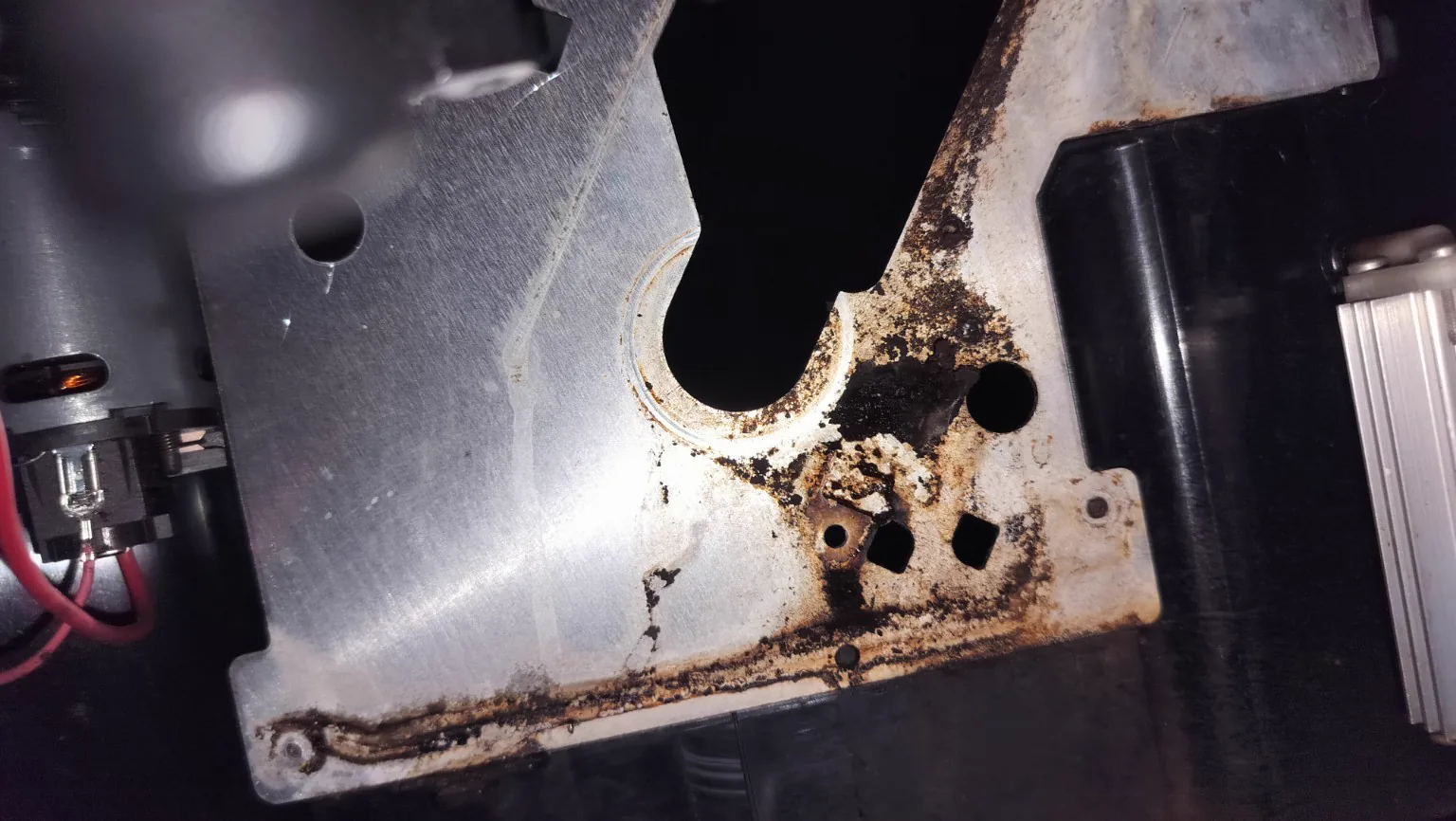
Workshop inspection found heavy coffee residue and dried moisture traces in the internal drainage area. Leak source still to be confirmed.
Miele Coffee Machine RepairThis record documents a separate workshop drainage inspection on a Miele CVA 6805. It concerns the internal drainage area, not the milk system, and no repair outcome or leak-source verification is claimed for it. It is included here as documentation of real KONGRA inspection work on CVA equipment only.
Manufacturer references
- Miele CVA 6805 operating instructions (PDF)CVA 6805 only (10 215 120/04). Care routines, milk-system cleaning and the published fault list apply to this model, not to CVA 7xxx machines.
- Miele CVA 7845 operating instructions (PDF)CVA 7845 only (12 860381/01/002). The automatic cleaning and rinsing routines it describes are documented for that specific model — not for every CVA 7xxx machine — and CVA 6xxx instructions do not apply to it either.
- Miele — no milk froth, or milk froth too runny or too thick from the central spout (CVA 5xxx built-in)Miele customer assistance for CVA 5xxx built-in appliances only. Other CVA series, and Miele CM countertop machines, use different assemblies and menus and are not covered by this article.
- Miele — milk froth not hot, or too runnyMiele customer assistance for milk froth temperature and consistency. Check that the article shown applies to your model series before relying on it; CVA built-in and CM countertop machines differ.
Related Miele and coffee machine pages
Frequently asked questions
What counts as a Miele CVA milk system fault?+
The milk system is the path milk actually travels: the container and lid, the milk line, the air intake, the frother or cappuccinatore assembly with its seals, and the cleaning programme that keeps that path clear. A fault anywhere along it can present as no milk drawn, steam only, weak or inconsistent froth, or a cleaning routine that will not complete. Which of those you are seeing changes what is inspected first.
Will descaling fix a milk problem?+
Descaling addresses the water circuit. It does not clean the milk path, and a restricted frother, a perished seal or a valve that is not operating will still be there afterwards. Both circuits are inspected during the visit so the actual cause is identified rather than assumed. Run descaling and milk-system cleaning only as the manual for your model specifies, with the products Miele specifies.
Does the model matter?+
Yes. CVA generations differ in the frother assembly, the milk connection arrangement, the cleaning programme and the way messages are presented, and Miele's own published guidance is written per model series. Miele CM countertop machines are a different product family again. Take the model number from the appliance rating plate before booking; guidance written for a different CVA series may describe parts and menus your machine does not have.
Do you always replace the whole milk assembly?+
No. The assembly is replaced only where inspection shows the assembly itself is at fault. Milk-path complaints also resolve at the line, the container connection, an insert, a seal or the air intake. The written estimate after inspection sets out which parts are actually required.
There is water or milk in the drip tray. Is that the milk system?+
Not necessarily. Liquid in the drip tray can come from the brew unit, the water circuit, condensate or the internal drainage path as well as from the milk system. Say where the liquid appears, what it looks like, and whether it appears after milk drinks specifically or after any drink, and photograph it before wiping it away.